
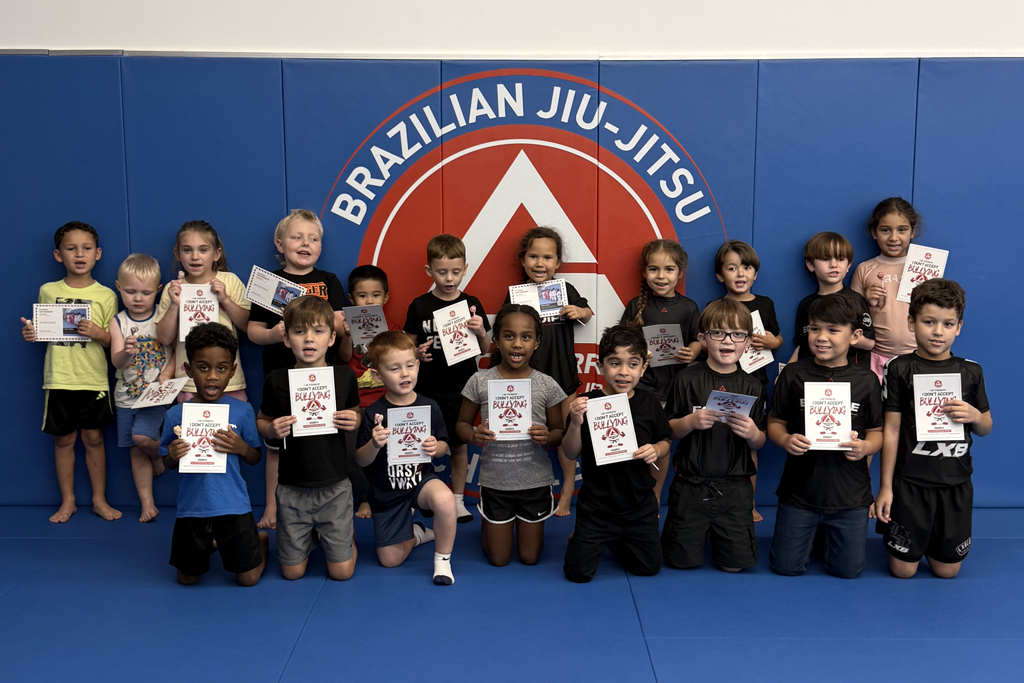
Bullying is one of the concerns that can lead parents to consider martial arts for their children.
But helping a child deal with bullying should involve much more than teaching them how to fight back.
A good martial arts program can help children develop confidence, awareness, communication skills, emotional control, and the ability to establish boundaries. Physical self-defense matters, but it should be part of a much broader set of skills that helps children recognize difficult situations and respond appropriately.
This is one of the reasons we believe Brazilian Jiu-Jitsu can be such a valuable experience for children.
If self-defense is one of the main reasons you’re considering martial arts, start with what is the best martial art for self-defense?
Bullying Isn’t Always Physical
When people hear the word bullying, they may immediately imagine a physical confrontation.
But bullying can take different forms.A child may experience repeated teasing, exclusion, intimidation, threats, unwanted physical contact, or other behaviors intended to make them feel powerless or uncomfortable.
That means preparing children to respond to bullying cannot begin and end with physical techniques.
They also need to learn how to recognize inappropriate behavior, communicate clearly, seek help from a trusted adult, manage their emotions, and understand when a situation requires them to remove themselves rather than engage.
The goal isn’t to make children more willing to fight. It’s to help them become more prepared to respond.
Confidence can change How A Child Responds
Confidence doesn’t guarantee that a child will never experience bullying. But it can influence how they respond when something feels wrong.
Children who gradually become more comfortable communicating, making decisions, dealing with pressure, and setting boundaries may feel better prepared to speak up or ask for help.
Martial arts provide repeated opportunities to practice these behaviors in a structured environment.
Children are challenged. They make mistakes. They interact with different training partners. They receive corrections. They experience moments of frustration and learn to continue.
Over time, those experiences can help build a more grounded kind of confidence based on what a child has learned to do, not simply on being told to “be confident.”
If you’re exploring how martial arts can support your child’s overall development, read what is the best martial art for kids?
Children Can Learn To Stay Calm Under Pressure
Knowing a technique is one thing. Being able to think when you’re uncomfortable is another.
Brazilian Jiu-Jitsu regularly puts students in controlled situations where they have to solve problems while another person is moving, applying pressure, or responding to what they’re doing.
For children, this creates opportunities to practice remaining calm when something doesn’t immediately go their way.
They learn that panic doesn’t usually solve the problem. They need to understand what’s happening, remember what they’ve learned, and make a decision.
That ability to pause, think, and respond is valuable far beyond Jiu-Jitsu.
Self-Defense Should Start Before A Fight
We believe one of the most important lessons children can learn about self-defense is that using physical techniques should not be the first solution to every conflict.
Whenever possible, children should understand the importance of awareness, communication, creating distance, setting boundaries, leaving the situation, and getting help from a trusted adult.
There is an important difference between confidence and aggression. Confidence can help a child stand their ground, communicate clearly, and make decisions without needing to prove anything.
Aggression can unnecessarily escalate a situation. A responsible martial arts program should help children understand that difference.
What if bullying becomes physical?
Avoiding conflict is important, but parents also want to know that their child has practical skills if a situation becomes physical and they cannot safely get away.
This is where Brazilian Jiu-Jitsu offers a particularly valuable perspective.
Jiu-Jitsu teaches children concepts such as positioning, balance, leverage, distance, and control rather than relying primarily on punches or kicks.
A child may encounter situations where someone pushes, grabs, holds, or knocks them down. Learning how to protect themselves and understand what to do in close physical contact can be an important part of self-defense education.
The goal isn’t to teach children how to punish another child. The goal is to give them tools to protect themselves, create an opportunity to get away, and seek help.
Parents who are concerned about the physical nature of training can read is brazilian jiu-jitsu safe for kids?
learning boundaries matters too
One of the less obvious benefits of martial arts is that children regularly practice physical and social boundaries.
They learn that training requires rules. They learn to listen when a partner communicates.
They learn that certain behaviors are acceptable in training only within a specific context and under instructor supervision.
They also learn that respect goes both ways. These experiences can help children develop a better understanding of appropriate interaction, personal space, communication, and responsibility toward others.
Martial Arts Shouldn’t Replace Communication With Parents And Schools
Martial arts can give children useful tools, but it should never be presented as a complete solution to bullying.
Parents, teachers, school administrators, and other trusted adults still have an important role. Children should know that asking for help is not a weakness.
If bullying is occurring, adults need to understand what is happening and respond appropriately. Martial arts can support a child’s confidence and preparedness, but children should not be made responsible for solving ongoing bullying entirely on their own.
Teaching a child to protect themselves should never mean teaching them that they have to face every problem alone.
Why We Believe Jiu-Jitsu Can Help
Brazilian Jiu-Jitsu offers something particularly valuable for children because many of its lessons are experienced rather than simply discussed.
A child doesn’t only hear about staying calm. They practice staying calm.
They don’t only hear about perseverance. They experience something difficult, make adjustments, and try again.
They don’t only hear about respecting other people. They need a training partner in order to learn, and both students are responsible for one another’s safety.
They don’t only hear that technique can overcome physical disadvantages. They experience how positioning, timing, and leverage work during training.
These repeated experiences can help turn abstract lessons into skills children begin to understand for themselves.
Why Families Choose Gracie Barra North Charleston
At Gracie Barra North Charleston, teaching children self-defense doesn’t mean teaching them to look for confrontation.
Our Future Champions program is designed to develop the child as a whole.
Alongside Brazilian Jiu-Jitsu, we work on values and behaviors such as respect, discipline, confidence, communication, responsibility, emotional control, and social skills.
Our programs are organized by age and developmental stage so that the way we teach evolves as children grow.
We also believe parents should be part of that development.
Through ongoing feedback, we keep families informed about their child’s progress, looking beyond technical improvement to areas such as confidence, focus, behavior, communication, social interaction, and how the child responds to challenges.
The goal isn’t to raise children who want to fight.
It’s to help develop children who are more aware, confident, responsible, and prepared to make good decisions when challenges arise.
Frequently Asked Questions:
Can martial arts stop my child from being bullied?
No activity can guarantee that a child will never experience bullying. Martial arts can, however, help children develop skills such as confidence, awareness, communication, emotional control, boundary-setting, and practical self-defense.
Should children fight back against bullies?
Physical confrontation should not automatically be the first response. Whenever possible, children should create distance, communicate boundaries, leave the situation, and involve a trusted adult. If a child cannot safely escape a physical situation, appropriate self-defense skills can become important.
Will learning jiu-jitsu make my child aggressive?
Learning Jiu-Jitsu does not need to mean encouraging aggression. A responsible children’s program should teach self-control, respect, responsible use of technique, and the difference between protecting yourself and unnecessarily escalating a conflict.
Is jiu-jitsu good for shy children?
It can provide shy children with regular, structured opportunities to communicate, work with partners, face manageable challenges, and gradually become more comfortable participating with others.
Every child is different, so progress should be allowed to happen at an appropriate pace.
Is jiu-jitsu safe for children?
Brazilian Jiu-Jitsu is a physical activity, so it isn’t completely risk-free. The structure of the program, age-appropriate instruction, supervision, training partners, and school culture all play important roles in managing risk.
For a more complete explanation, read is brazilian jiu-jitsu safe for kids?
Schedule a Visit
If bullying or self-defense is part of the reason you’re considering martial arts for your child, we encourage you to look beyond the techniques when choosing a school.
Look at the environment. Meet the instructors. Ask how they teach children to handle conflict, frustration, boundaries, and responsibility.
Schedule a visit to Gracie Barra North Charleston, meet our team, learn about our Future Champions program, and see how we approach self-defense as part of something bigger: helping children become more confident, capable, and prepared for life’s challenges.

