Gracie Barra North Charleston | Jiu-Jitsu and Martial Arts Academy

Rodrigo Fajardo: More Than a Competitor — A Career Within Gracie Barra
Rodrigo Fajardo is a 4th-degree Brazilian Jiu-Jitsu black belt, graduated by Gustavo Muggiati, who has been his professor since the beginning of his journey.
His relationship with Jiu-Jitsu began in October 2000, in Curitiba, Brazil, when he was 14 years old. More than two decades later, his career encompasses much more than competition. He has worked as an athlete, instructor, academy owner, manager, coach, curriculum contributor, instructor developer, event organizer, and regional developer within Gracie Barra.
His story is closely connected to the development of Gracie Barra itself.
From Student to Gracie Barra Instructor
When Rodrigo began training, the academy in Curitiba was known as Gracie Curitiba. The school was already connected to Gracie Barra and competed representing the association, although the “Gracie Barra + locality” naming convention was not yet widely used outside Rio de Janeiro. Beginning in 2002, that naming format became standardized, and the academy became known as Gracie Barra Curitiba.
Rodrigo experienced this evolution from inside the academy.
He began assisting with instruction in 2002 and became an instructor in 2003.
At only 19 years old, while still a brown belt, Rodrigo assumed responsibility for Gracie Barra Curitiba. At the time, the academy had approximately 70–80 students and a strong competitive culture.
This was the beginning of two careers that would remain connected throughout his life: the career of a Jiu-Jitsu professional and the career of an entrepreneur within Jiu-Jitsu.
From that point forward, teaching and managing an academy became as important to his development as training and competing.
A Career Built Through Competition
Competition played an important role in Rodrigo’s technical development.
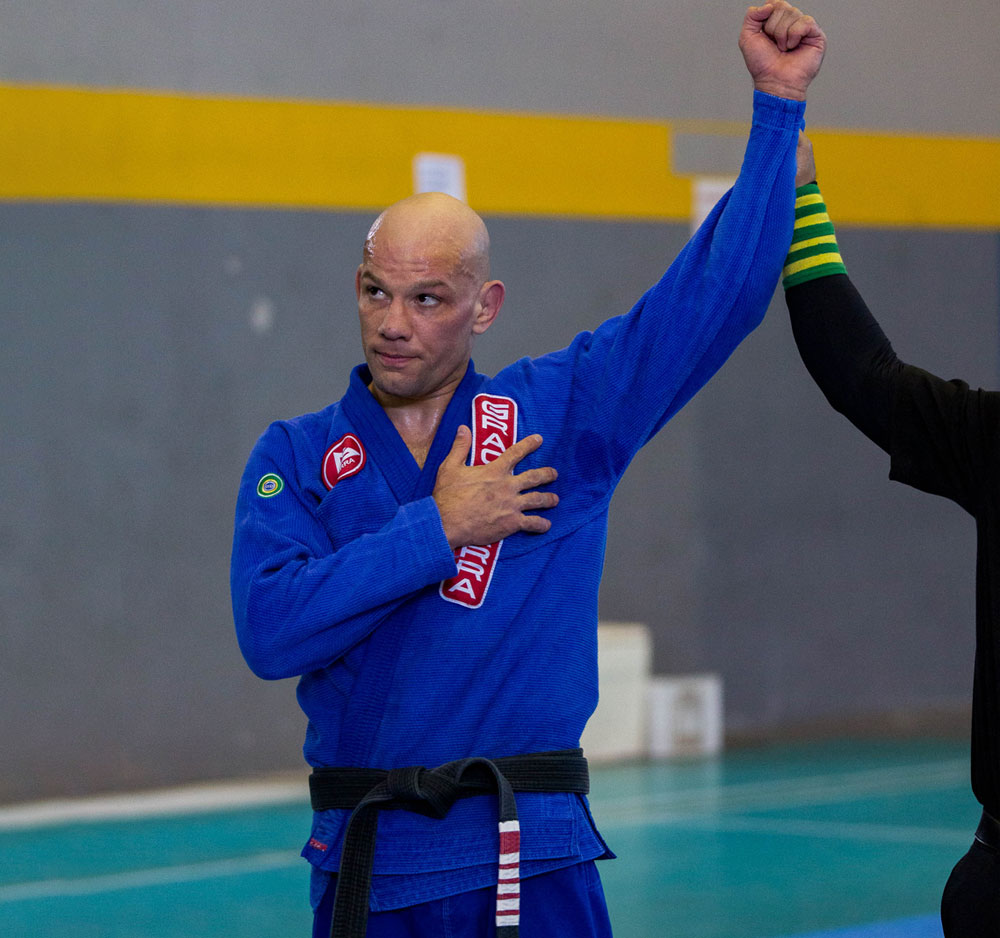
He competed extensively throughout Brazil and internationally, primarily in the Medium Heavyweight division. His competitive career includes Brazilian, South American, European, Pan-American, South-Brazilian, World Master, and International Open championships and podium finishes.
Among his major competitive results are:
- European IBJJF Champion — Adult Black Belt, Medium Heavyweight
- Brazilian Jiu-Jitsu Champion — Adult Black Belt, Medium Heavyweight
- South American Champion — Adult Black Belt, Medium Heavyweight
- Pan IBJJF Champion — Master 2 Black Belt, Medium Heavyweight
- Curitiba International Open Champion
- Floripa International Open Champion
- South-Brazilian Champion on multiple occasions
- Gramado International Open Champion — Medium Heavyweight and Absolute
- World Master IBJJF Championship podium finisher
- Multiple Pan-American, European, Brazilian, South American, South-Brazilian, and International Open podium finishes
His competitive experience spans multiple stages of his development. Rodrigo became a Brazilian champion in different belt divisions, including yellow, blue, purple, brown, and black belt.
Competition provided more than titles. It became a practical education in preparation, pressure, strategy, coaching, performance analysis, and the process of helping athletes develop.
As his responsibilities within Gracie Barra increased, that experience became increasingly valuable not only for his own career but also for the students and competitors he coached.
From Athlete to Academy Owner
Managing an academy at 19 forced Rodrigo to develop skills that went beyond Jiu-Jitsu technique.
He had to learn how to manage finances, contracts, employees, students, sales, planning, operations, and the day-to-day responsibilities of running a business.
The early years were also a period of trial and error. Rodrigo had to learn how to transform a Jiu-Jitsu academy from a place centered around training and competition into a sustainable professional organization.
Over time, his understanding of success changed.
Initially, success was strongly associated with winning championships, developing as an athlete, and building a respected academy.
Later, success increasingly included developing people, creating capable teams, establishing processes, and building an organization that could continue to grow without depending entirely on one individual.
That change in perspective became an important part of his development as a leader.
Regional Development in Paraná
As his experience increased, Rodrigo began contributing to the development of other Gracie Barra academies in Paraná.
He opened different units directly and also worked with other professors, students, and academy owners who were developing their own schools.
His work as a regional collaborator included sharing experience and helping academy owners and instructors with teaching methodology, leadership, student development, academy management, and operational processes.
At different points, he was involved with approximately six academies, including Gracie Barra Ponta Grossa.
The objective was not simply to open more schools. It was to develop people capable of leading those schools.
Today, the Gracie Barra network in Paraná includes 57 academies, with 26 in the Curitiba region. Rodrigo considers this development a collective achievement involving many professors, owners, instructors, students, and leaders over many years.
His contribution was one part of that larger process.
2016: A New Personal Chapter
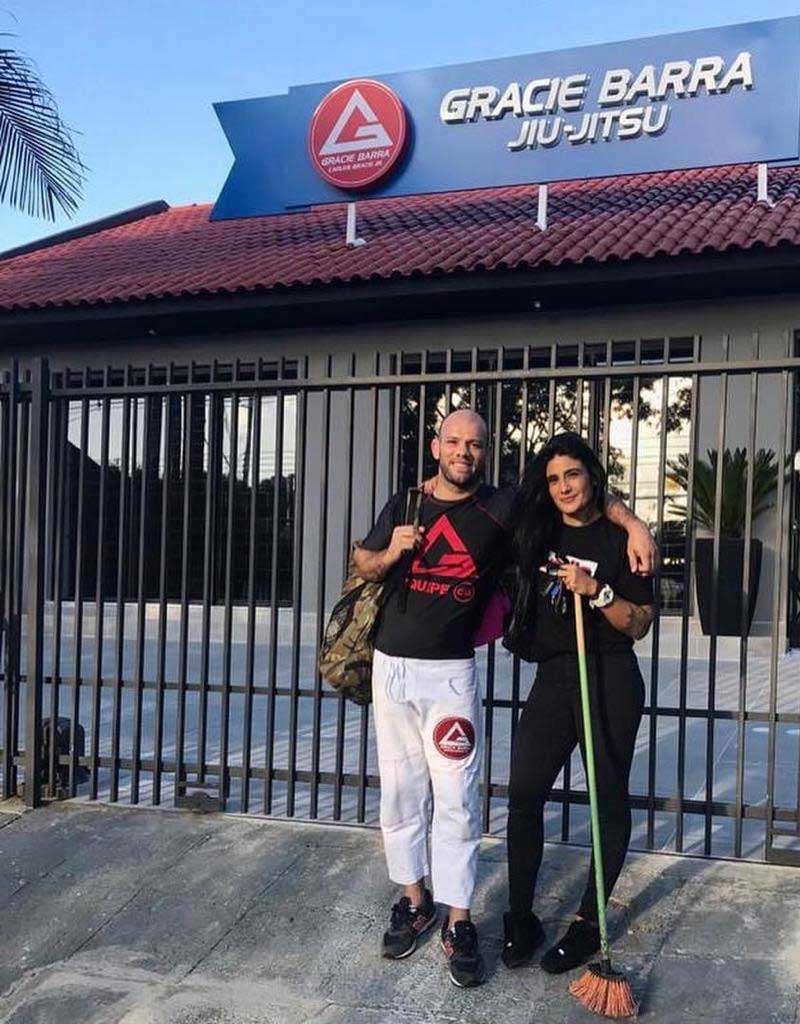
In 2016, Rodrigo began his relationship with Nika Schwinden.
At that time, his professional journey was already established. He had spent years competing, teaching, managing academies, and contributing to the development of Gracie Barra in Paraná.
In 2018, their relationship also became a professional partnership.
This distinction is important in understanding the evolution of Rodrigo’s career.
From 2018 onward, Rodrigo and Nika began working increasingly closely on the development of Gracie Barra Curitiba and other Jiu-Jitsu projects.
Their professional partnership brought together different areas of expertise and perspectives. Rodrigo’s background was strongly connected to competition, technical teaching, academy management, and regional development, while Nika developed a significant role in student experience, instructor development, and particularly the development of the Gracie Barra women’s program.
Together, they began working on management, methodology, instructor development, student relationships, programs, community experience, and long-term growth.
A Different Approach to Academy Development
The partnership with Nika coincided with an important transformation at Gracie Barra Curitiba.
In 2018, Rodrigo sold the second academy he had opened, Gracie Barra Água Verde, and concentrated his efforts again on the main academy, then locally known as Gracie Barra Cabral.
The academy also moved to Rua México.
Reducing the number of operations allowed Rodrigo and his team to concentrate more deeply on teaching quality, instructor development, student development, community experience, and operational sustainability.
The experience reinforced an important distinction in Rodrigo’s approach to leadership:
Expansion means increasing the number of units.
Development means increasing the capability of the people and organization.
That distinction became increasingly important in the years that followed.
The goal was no longer simply to make the academy larger. It was to make the organization stronger.
Building an Academy Around Different Student Journeys
As Gracie Barra Curitiba developed, Rodrigo and Nika increasingly recognized that not every student enters Jiu-Jitsu for the same reason.
Some students want to compete.
Others are looking for discipline, confidence, personal development, health, relationships, family experiences, or simply a meaningful activity in their routine.
The academy therefore needed to be able to serve different types of students without losing its identity as a Jiu-Jitsu academy.
This perspective also changed the way instructors were developed.
The goal was not simply to teach professors more techniques. It was to prepare them to work with different programs and different audiences, communicate effectively, understand their responsibilities, and create a consistent experience for students.
For Rodrigo, developing instructors became one of the most important ways of multiplying the impact of his own experience.
Contribution to Gracie Barra
Rodrigo’s contribution to Gracie Barra extends beyond his own academies.
Among the main areas of contribution are:
- More than two decades within Gracie Barra
- Academy owner since the age of 19
- Instructor within Gracie Barra since 2002
- Development and support of multiple Gracie Barra academies in Paraná
- Regional collaboration and development of instructors and academy owners
- Contribution to GB1 and GB2 curriculum development
- More than 100 technique videos produced for GB Online
- Participation in international Gracie Barra events, congresses, and World Summits
- Development of more than 20 professionals through Casa GB / Instituto Jiu-Jitsu para Todos
- Management and development of Gracie Barra Curitiba and Gracie Barra North Charleston
- Approximately 1,000 students across the two schools and approximately 30 professionals
- Development of teaching methodologies, programs, student experience, and academy operations
- Competition coaching and athlete development
- Regional development work within Gracie Barra South Carolina
GB Online and Curriculum Development
Rodrigo was also involved in the development of Gracie Barra’s digital curriculum.
Before the pandemic, he participated in the recording of the GB2 curriculum, involving approximately 96 Gi techniques.
The project required more than simply demonstrating techniques. The knowledge had to be organized in a way that could be understood and reproduced by students and instructors who were not physically present with the professor.
It became the first complete Gracie Barra curriculum recorded in Portuguese in that format.
During the pandemic, Rodrigo agreed to make the content available free of charge to the Gracie Barra community, helping students maintain a connection with Jiu-Jitsu while in-person training was interrupted.
His work with GB Online eventually included more than 100 technique videos and contributions related to the GB1, GB2 and GB3 curriculum.
This experience reinforced another aspect of his professional development: transforming practical knowledge accumulated through years on the mat into structured educational material.
Casa GB and Instituto Jiu-Jitsu para Todos
The work of developing students and instructors eventually expanded beyond the traditional academy environment.
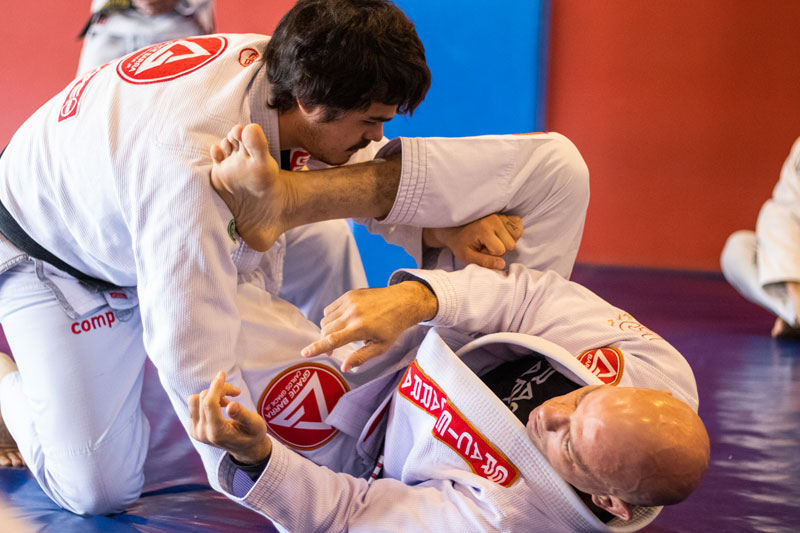
Together with Nika, Rodrigo developed Casa GB and later Instituto Jiu-Jitsu para Todos.
The initiative was designed to create opportunities for young people to develop professionally through Jiu-Jitsu.
The objective was not simply to develop athletes.
Participants could learn how to teach Jiu-Jitsu, work with different age groups, understand Gracie Barra programs, develop communication skills, work with students and families, learn aspects of sales and relationship management, and develop professional skills.
More than 20 professionals were directly developed through this work, with former participants going on to work in different regions and countries.
For Rodrigo, this represents one of the clearest examples of the multiplying effect of Jiu-Jitsu: a student becomes a professor, the professor becomes a leader, and the leader can develop new professors.
International Experience
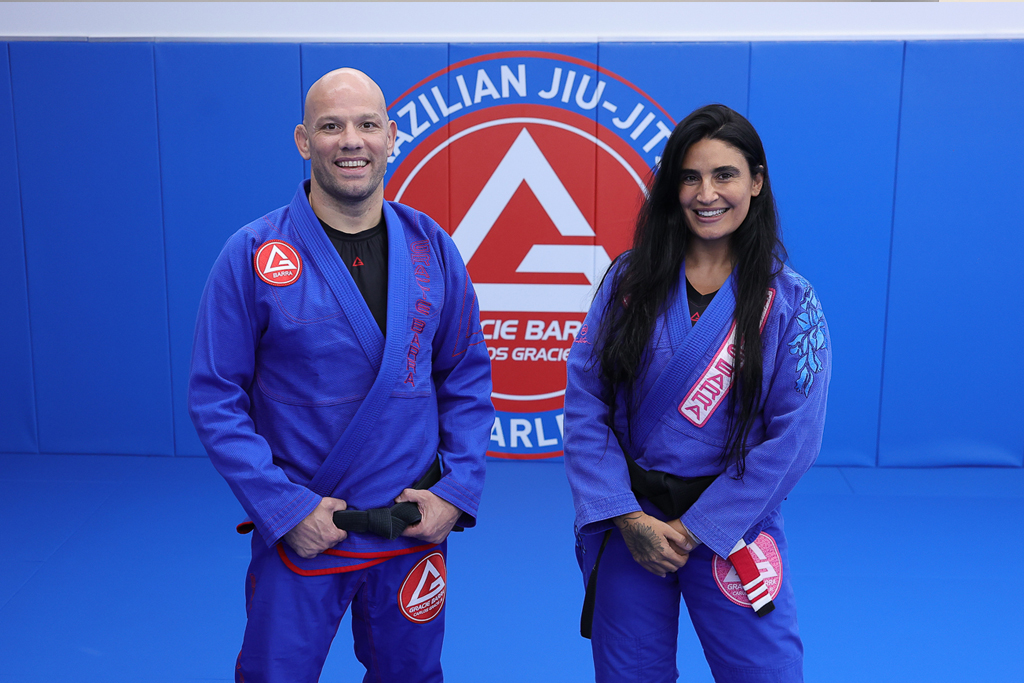
Rodrigo has also represented Gracie Barra through seminars, educational programs, congresses, and international events.
He has taught seminars in Brazil and in countries including the United States, Spain, Portugal, Germany, South Africa, Paraguay, Argentina, and Ecuador.
He has participated in multiple Gracie Barra World Summits and international congresses.
In 2022, he participated in a World Summit interview discussing competitive Jiu-Jitsu.
He also participated in presentations related to academy management technology, including the GB App.
These experiences expanded his role from competitor and instructor to educator, allowing him to exchange knowledge with professors and practitioners from different parts of the Gracie Barra community.
From Curitiba to South Carolina
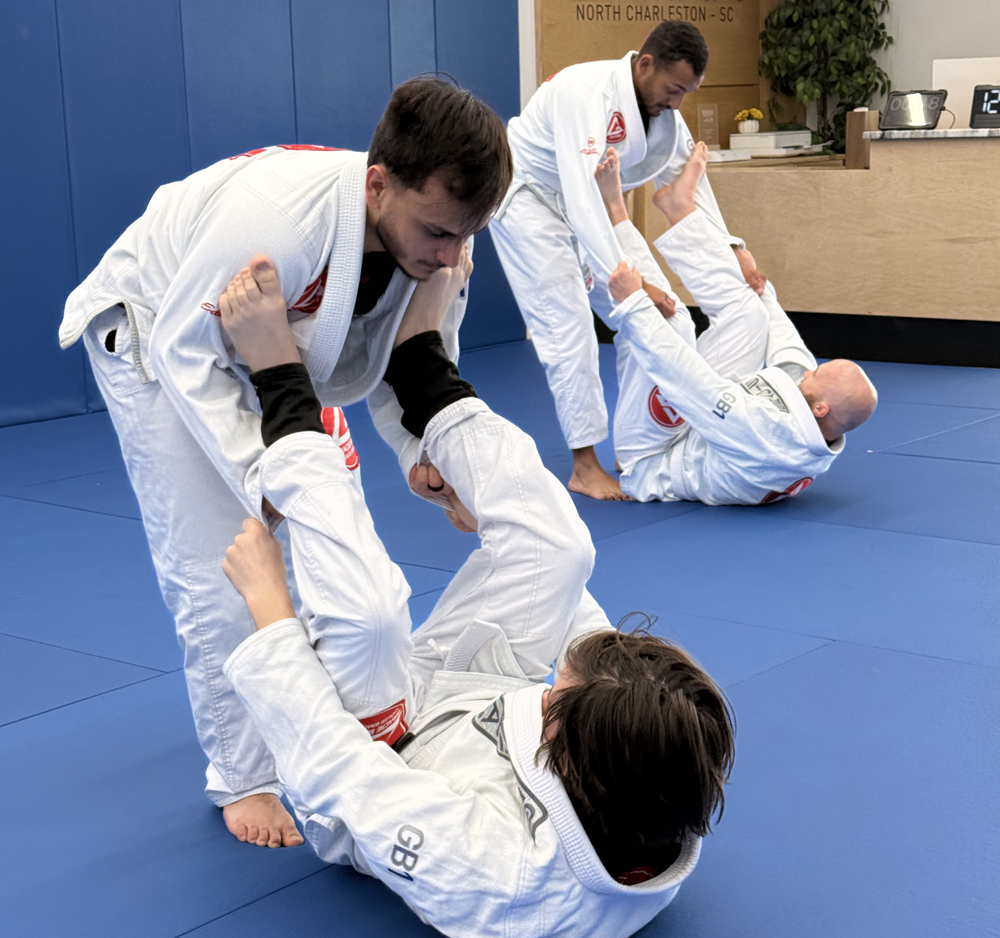
In 2024, Rodrigo moved to South Carolina, beginning a new stage of his professional journey in the United States.
He began working directly with Gracie Barra North Charleston while maintaining his involvement with Gracie Barra Curitiba.
The two schools currently represent approximately 1,000 students and approximately 30 professionals.
This new chapter brought together many of the skills developed throughout his career: teaching, academy management, instructor development, competition coaching, program development, leadership, and community building.
In 2026, Rodrigo also became part of the Gracie Barra South Carolina Development Council, expanding into the United States the regional development work he had previously performed in Paraná.
His current work includes helping academies develop students, professors, leadership, operations, standards, and student experience.

Contribution to Gracie Barra South Carolina
Rodrigo’s role in South Carolina represents a continuation of the same development philosophy he built throughout his career.
The objective is not simply to reproduce the structure of Gracie Barra Curitiba in another location.
South Carolina has its own market, communities, students, professionals, and challenges.
The role of regional development is therefore to apply principles while adapting them to the local reality.
This includes:
- Developing professors
- Supporting academy owners
- Improving operational processes
- Strengthening student experience
- Creating competitive opportunities
- Supporting leadership development
- Maintaining Gracie Barra standards
- Helping academies build sustainable operations
- Connecting academies and strengthening the regional community
Rodrigo is also continuing his involvement with CompNet. In Paraná, he worked alongside Nika in developing competitive events capable of bringing together athletes and academies from across the region. In the Carolinas, he is working alongside Nika and Henrique Carepa to develop competitive opportunities and strengthen connections between Gracie Barra academies.
Competition remains an important part of this work, but it is not the only objective. The goal is to create opportunities both for experienced competitors and for students participating in their first competition.
More Than a Competition Record
Rodrigo Fajardo’s competition record is an important part of his history, but it represents only one dimension of his career.
His professional journey within Gracie Barra has included more than two decades of continuous development:
- From student to instructor
- From competitor to coach
- From instructor to academy owner
- From academy owner to regional collaborator
- From practitioner to curriculum contributor
- From teacher to teacher developer
- From managing one academy to helping develop multiple academies
- From developing students to developing professionals
His experience has gradually expanded from learning Jiu-Jitsu to understanding how Jiu-Jitsu can be taught, organized, managed, and used to develop people.
Today, Rodrigo continues this work through Gracie Barra North Charleston, Gracie Barra Curitiba, and his regional responsibilities in South Carolina.
The championships remain part of the story.
But the broader measure of his career is found in the students who stayed, the athletes who developed, the professors who were formed, the academies that grew, the professionals who built careers through Jiu-Jitsu, and the leaders who went on to develop others.
That is the continuing journey of Rodrigo Fajardo within Gracie Barra.
