
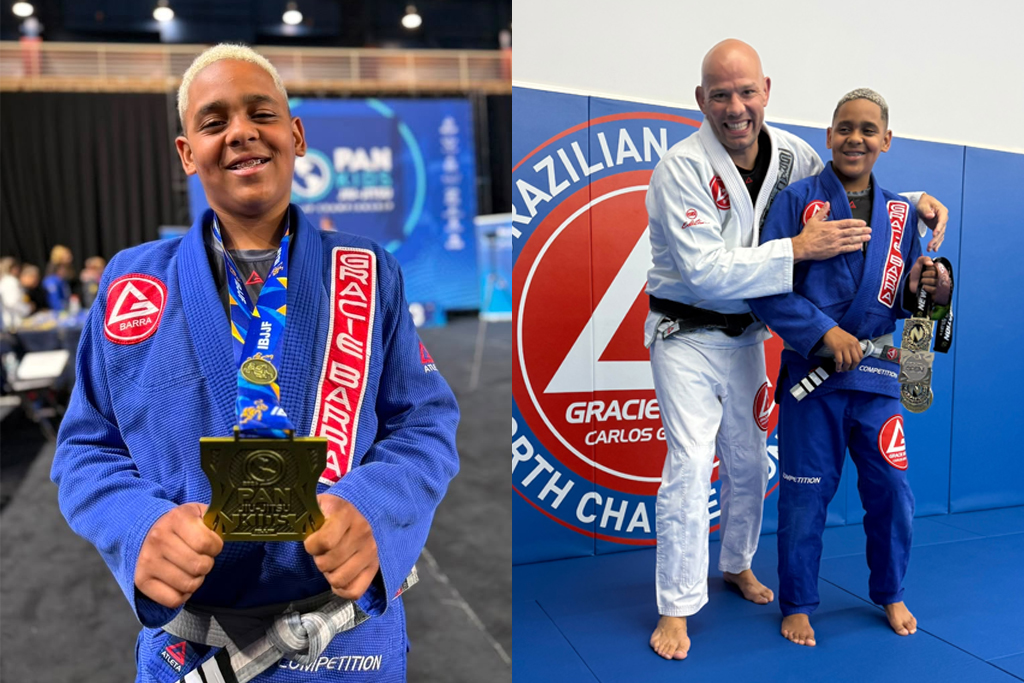
When Pedro first walked into Gracie Barra North Charleston, he was 10 years old and just beginning his Jiu-Jitsu journey. Like every new student, he had a lot to learn. New techniques, new challenges, a new environment, and the experience of discovering what he was capable of on the mats.
It did not take long for competition to become part of that journey. Pedro began competing as a white belt, entering an environment that was already familiar to the Gracie Barra North Charleston community. Our Professors regularly compete at major tournaments, and students at different stages of their Jiu-Jitsu journeys have the opportunity to challenge themselves through competition when it makes sense for them.
For Pedro, that opportunity came early. With the encouragement, support, and investment of his parents, tournaments became another way to learn, test himself, and experience Jiu-Jitsu beyond the familiar environment of his school.
In less than a year of training, Pedro has already competed in several tournaments both in and outside the city, collected multiple medals, and earned third place at the IBJJF Kids Pan-American Championship. Those results are worth celebrating. But when we look at everything that has happened along the way, the medals tell only part of the story.
Pedro’s journey is also an example of how competition, when approached with the right perspective, can become a valuable part of a child’s development.
why compete when you are still a beginner?
It can be easy to assume that children should wait until they are highly experienced before entering a Jiu-Jitsu competition. For many young students, however, competing while they are still beginners can become part of the learning process itself.
A tournament introduces a child to a different kind of challenge. The environment is unfamiliar. The opponent may be someone they have never met. There is anticipation before the match, uncertainty about what will happen, and a limited amount of time to apply what has been learned in training.
For Pedro, beginning to compete as a white belt meant learning early that being prepared does not mean knowing exactly what will happen. It means trusting the work that has already been done and learning how to respond when things do not go according to plan.
This is one of the reasons Jiu-Jitsu can offer children experiences that extend beyond learning martial arts techniques. In what is the best martial art for kids?, we discuss how the right martial arts environment can contribute to a child’s physical, social, and personal development.
Training for something changes the way a child experiences progress
Regular classes already give children opportunities to learn techniques, solve problems, work with partners, and gradually improve. Preparing for competition adds something different: a concrete challenge on the horizon.
There is a date on the calendar and an event to prepare for. Training begins to have another layer of meaning because the child knows there will be an opportunity to test what has been practiced in an unfamiliar situation.
That does not mean every training session needs to become about winning. In fact, one of the most valuable lessons competition can offer is understanding the difference between preparation and outcome.
A child can train hard and still lose a match. They can perform well and not receive a medal. They can also win and still discover things that need improvement. When the adults around them help keep those experiences in perspective, competition can teach children to pay attention not only to the result, but also to the process that led them there.
Pedro’s experience reflects that process. Each tournament has given him another opportunity to train with purpose, step into a new environment, test himself, and return to the school with more experience than he had before.
learning to deal with both success and frustration
One of the valuable aspects of competition is that it creates experiences adults cannot completely control for a child. There will be victories, but there may also be losses. There can be excitement, nervousness, disappointment, pride, frustration, and relief, sometimes all within the same tournament.
The goal is not to prevent children from experiencing those emotions. It is to help them learn how to respond to them.
Since beginning his competition journey, Pedro has had opportunities to develop confidence, self-control, and discipline while learning how to face challenges, frustrations, and unfamiliar situations. These lessons are not separate from his Jiu-Jitsu development. They are part of it.
A medal provides a visible result from a particular day. Learning to return to training after a difficult experience, listen to feedback, identify what can improve, and continue working is a different kind of achievement, and one that can remain valuable long after a tournament ends.
competition can build confidence without making everything about winning
Confidence in children is sometimes misunderstood as simply feeling certain that they will succeed. Jiu-Jitsu can help children experience another kind of confidence: being willing to face something even when the outcome is uncertain.
Pedro did not need to become an advanced student before stepping into competition. He began doing it as a white belt. With each tournament, the experience itself became more familiar, and he had another opportunity to discover how he responded under pressure.
That distinction matters because confidence is not built only through success. It can also develop when a child realizes that they can enter an uncomfortable situation, do their best, learn from what happened, and move forward afterward.
The same principle applies when a child first begins Jiu-Jitsu. New students are not expected to arrive confident, coordinated, or already comfortable on the mats. They develop those things through experience. For parents wondering what that beginning looks like, what happens in your first Jiu-Jitsu class explains how children and adults are introduced to the training environment.
The role of parents in a young competitor’s journey
Pedro’s story also highlights something that deserves attention: the role his parents have played throughout this process.
Youth competition requires commitment beyond the child who steps onto the mat. There are tournament registrations, travel, preparation, schedule adjustments, and the emotional support that comes before and after competition. Pedro has been able to build these experiences because his parents chose to support and invest in this part of his development.
That support becomes especially meaningful when the focus remains larger than the medal.
Children naturally care about winning, and there is nothing wrong with wanting to win. Competition is competition. But when parents and Professors also value preparation, courage, behavior, learning, and the way a child responds to both victory and defeat, the tournament can become much more than a test of who scored more points in a match.
It becomes another environment in which the child is learning how to grow.
Competition is part of the learning environment at Gracie Barra North Charleston
Pedro’s experience with competition is also part of a larger culture at Gracie Barra North Charleston. Competition is present in our school at different levels of experience, from Professors who regularly test themselves at major tournaments to students who are still taking their first steps in Jiu-Jitsu.
For younger and less experienced students, seeing their Professors and teammates compete can make tournaments feel like a natural extension of training rather than something reserved only for advanced athletes. They see that preparation, nervousness, difficult matches, victories, losses, and the process of returning to the mats afterward are all part of the experience.
That does not mean every student is expected to compete. Competition remains an individual choice and should make sense for each student and family. But for those who want to experience it, being surrounded by people who understand competition creates an environment where they can prepare with guidance and learn from others who have already been through the same process.
Our school has already seen this competitive culture translate into results across different levels. At CompNet Carolinas, for example, Gracie Barra North Charleston finished first place as a team, an achievement built through the participation and performance of our students. Read more about Gracie Barra North Charleston’s first-place finish at CompNet Carolinas.
What matters about results like these is not only the trophy itself. They reflect something that happens long before competition day: students training together, Professors sharing their own competitive experience, teammates helping one another prepare, and beginners learning that they can challenge themselves even while they are still developing their Jiu-Jitsu.
Pedro is part of that environment. He began competing as a white belt, surrounded by a school community in which competition can be understood not only as an opportunity to pursue a result, but also as another opportunity to learn.
From local tournaments to the IBJJF Kids Pan-American Championship
In less than one year of Jiu-Jitsu, Pedro has already accumulated experiences at multiple competitions, traveling both within and outside the city to compete.
Among those experiences was one of his most significant results so far: a third-place finish at the IBJJF Kids Pan-American Championship.
Placing at a major competition is an important accomplishment, especially so early in his Jiu-Jitsu journey. It reflects the training and preparation that brought Pedro to that moment and deserves to be celebrated by his family, Professors, teammates, and school.
At the same time, looking only at the podium would leave out much of what makes his journey valuable. Every tournament before and after that result contributes something. Each match gives him information about his Jiu-Jitsu. Each preparation cycle asks for discipline. Each unfamiliar opponent creates a new problem to solve. Each result gives him another opportunity to understand how to respond and what to work on next.
The medal marks an achievement. The experiences surrounding it are helping shape the student, competitor, and person Pedro is becoming.
Should every child who trains Jiu-Jitsu compete?
Pedro’s experience does not mean that every child needs to compete in order to benefit from Jiu-Jitsu.
Children have different personalities, goals, levels of readiness, and reasons for training. Competition can be an important part of the journey, but it is not the only path to progress.
What Pedro’s story demonstrates is what competition can offer when a child is interested, appropriately prepared, and supported by parents and Professors who understand that development is bigger than a tournament result.
For some children, competition provides a goal that increases motivation. For others, it offers an opportunity to become more comfortable with pressure and uncertainty. It can reveal areas that need improvement, create new experiences, and provide lessons about preparation, resilience, self-control, and sportsmanship.
Just as important is the environment surrounding the child. Parents considering Jiu-Jitsu should look not only at what is taught, but also at how children are coached, supported, and challenged. Our article how to choose the right martial arts school in North Charleston explores some of the factors families can consider when evaluating a martial arts school.
A journey that is only beginning
Pedro has been training for less than a year, and that fact puts everything else into perspective. There are already tournaments, trips, difficult matches, victories, frustrations, lessons, medals, and a third-place finish at the IBJJF Kids Pan-American Championship. But there is also an enormous amount of his Jiu-Jitsu journey still ahead of him.
Pedro is also becoming part of a competitive culture that continues to grow at Gracie Barra North Charleston. He trains alongside students who are learning to challenge themselves and is guided by Professors who continue to step into major competitions themselves. In that environment, competition is not something students simply watch from a distance. For those who choose it, it can become another part of the learning process.
We are proud of the medals Pedro has earned, just as we are proud of the competitive results our school has achieved together. But the value of those results goes beyond the podium. They represent preparation, shared experience, courage, discipline, and the willingness to keep learning.
For a 10-year-old who walked into our school as a beginner, competition has already provided opportunities to discover that preparation matters, challenges can be faced, setbacks can become lessons, and progress is built over time. Pedro’s medals show what he has already accomplished in competition, but his journey shows something even more important: how much can be built through everything that happens before and after stepping onto the competition mats.
And his journey is only beginning.
Frequently asked questions:
Can beginners compete in Jiu-Jitsu?
Yes. Jiu-Jitsu competitions commonly organize competitors according to factors such as age, belt level, and weight, giving beginners opportunities to compete with students at similar stages of development. Whether and when a child should compete is something parents can discuss with their child’s Professor based on the individual student’s preparation, interest, and readiness.
What can children learn from Jiu-Jitsu competition?
Competition can give children opportunities to experience preparation, discipline, emotional control, problem-solving, sportsmanship, and the process of responding to both success and disappointment. These experiences can make tournaments valuable even when the final result is not a medal.
Does my child have to compete if they train Jiu-Jitsu?
No. Competition is one possible part of a child’s Jiu-Jitsu journey, not a requirement for receiving the broader benefits of training. Children can develop their Jiu-Jitsu, confidence, physical abilities, friendships, and personal skills without competing.
Why can competing as a beginner be valuable?
Beginning competition early can give interested students an opportunity to experience pressure, unfamiliar opponents, preparation, and the relationship between training and performance while they are still developing their Jiu-Jitsu. The objective does not have to be immediate competitive success. The experience itself can become part of the learning process.
Does Gracie Barra North Charleston participate in Jiu-Jitsu competitions?
Yes. Competition is present at different levels within our school. Our Professors regularly participate in major competitions, and students ranging from beginners to more experienced practitioners also have opportunities to compete. Gracie Barra North Charleston has achieved strong results as a team as well, including a first-place team finish at CompNet Carolinas.
How can my child start Jiu-Jitsu at Gracie Barra North Charleston?
If you are considering Jiu-Jitsu for your child, schedule a visit to Gracie Barra North Charleston. You can meet our team, learn about our kids programs, see the training environment, and understand how we support children throughout their Jiu-Jitsu journey, whether competition eventually becomes part of that journey or not.

